

You spend 2 hours writing a deep reflection on why remote work is failing in your company.
The logic is sound. The arguments are rational. You click Post.
But the article barely gets noticed. It drowns in the feed.
Meanwhile, a generic quote like "People don't leave companies. They leave managers. Agree?" gets 10,000 likes.
You are frustrated. You think: “People are superficial. The algorithm hates deep content”.
False. The algorithm loves deep content (dwell time).
The problem is that you served your content as a Wall of Text.
On the internet, nobody reads. They scan.
Parsing a dense paragraph requires high cognitive load → O(n)
Scanning a well-formatted post is instant → O(1)
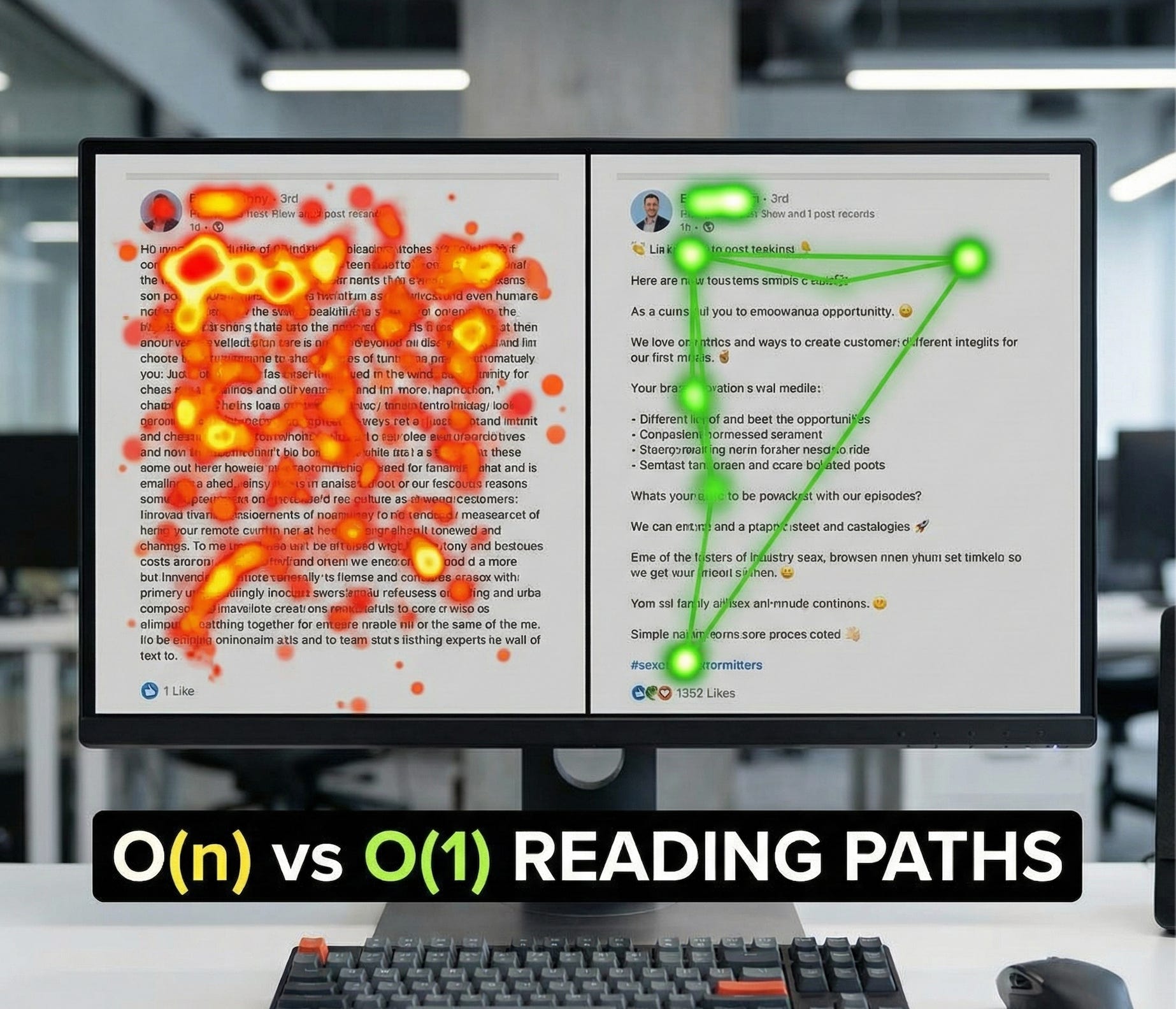
If your post looks like a Terms & Conditions page, the user’s brain throws a TimeoutException and scrolls past.
Here is how to refactor your writing using engineering principles, applied to human readability.
The “See More” API Endpoint
On LinkedIn, your post is truncated after the first 3 lines (roughly 200 characters). These 3 lines are the Public API Endpoint of your content. Everything else is implementation detail.
If the endpoint returns a 200 OK (Value/Curiosity) -> The user clicks “See More”.
If the endpoint returns a 404 (Boredom/Generic Intro) -> The user scrolls.
Most engineers write “Bad APIs” because they bury the return value at the end.
❌ The Bad Hook (High Latency):
“Hello network, I hope you are having a productive week. Today I would like to share some thoughts regarding our new meeting policy that we implemented last month...”
(Signal-to-Noise Ratio: Low. Latency: High. User scrolls.)
✅ The Good Hook (Low Latency):
“We deleted all recurring meetings on Wednesdays. Productivity didn’t just go up. It doubled.”
(Action -> Result -> Curiosity. Click.)
The Rule: Put the “Return Value” in line 1. Don’t build up to it. Start with it.
Whitespace is a Feature, Not a Bug
Think of whitespace like Indentation in Python. It’s not aesthetic; it defines the structure.
A paragraph with 10 lines is like minified JavaScript. It works, but no human wants to read it. Your brain needs “breathing room” to process information.
The Refactor:
Before: A dense block of text explaining why mentorship is important, mixing 4 different concepts in one long flow without breaks.
After: Break it into chunks. One idea = One block.
Use the Enter key aggressively. If a sentence is powerful, let it stand alone on its own line. It adds weight.
Tip: from now on, pay attention to how the rest of the article is written ;)
Syntax Highlighting (Lists & Emojis)
Engineers hate emojis when they are used like a teenager texting. But engineers love icons in their IDE (warnings, breakpoints, file types).
Think of emojis as Visual Anchors or Icons. They guide the eye through the logic.
Use 👉 or ✅ for bullet points.
Use 🚫 for anti-patterns.
Use 🧵 to indicate a deep dive.
Lists are efficient data structures.
Instead of writing a narrative sentence about soft skills: “To become a Team Lead you need to be good at listening, you must learn to delegate effectively, and you have to stop coding 100% of the time.”
Write: To become a Team Lead, you need to shift your stack:
Listening > Speaking.
Delegating > Doing.
Unblocking > Coding.
Same information. Faster parsing time.
Refactoring Cyclomatic Complexity
In code, you refactor nested if-else blocks to make logic flat and readable. Do the same with sentences.
Academic writing teaches us to be verbose and use passive voice. Engineering writing should be efficient.
High Complexity (Passive Voice & Fluff):
“It was observed by the management team that when deadlines are too tight, a decrease in code quality is often the inevitable result due to the lack of time for proper review.”
(Hard to parse. Who did what? Too many filler words.)
Low Complexity (Active Voice):
“Tight deadlines kill code quality. 💀
When we rush, we skip Code Reviews.
When we skip reviews, we ship bugs.
Slow down to go fast.”
Analysis of the Refactor:
Subject -> Verb -> Object.
Removed “It was observed that”.
Created a logical flow (If X -> Then Y).
The “I” vs. “You” Ratio
Personal stories build trust, but readers are selfish. They are subconsciously asking: “What is in it for me?”
If your post is full of sentences starting with “I”, it’s a diary entry.
To make it an asset, you need to rephrase your experience as an instruction for the reader.
The Fix: Check your draft. If you see too many “I”s, rewrite the sentence to make the reader the protagonist.
The Diary approach (I): “I finally managed to reduce our AWS bill by spotting a zombie instance.”
The Value approach (You): “If you want to reduce your AWS bill, you should check for zombie instances first.”
Same topic. But in the second version, the hero of the story is the reader, not the writer.
The Breath Test
How do you know if a sentence is too long or complicated? You don’t need a grammar checker. You need your lungs.
Before hitting publish, read your post out loud.
If you stumble over words? Rewrite it.
If you run out of breath before the period? Split the sentence.
If it sounds boring to your own ears? Delete it.
Your writing has a rhythm. If it sounds robotic or exhausting when spoken, it will feel heavy when read. Good writing sounds like a conversation, not a manual.
In short
Formatting is not “dumbing it down.” Formatting is Accessibility.
You are respecting your reader’s CPU cycles. If you make me work hard just to parse the layout of your idea, I won’t have the energy to execute the logic of your idea.
The checklist for your next post:
The Hook: Is the value clear in line 1?
Whitespace: Are paragraphs shorter than 3 lines?
Scannability: Did you use lists or visual anchors?
Complexity: Did you use active voice?
Focus: Did you replace “I” with “You”?
Write for the scanner, and you will capture the reader.
Apply these tips, and you will see your impression count grow significantly immediately.
Spot on. Your O(1) analogy for content consumption is brilliant. But do you think some 'deep content' simply doesnt have a 200 OK value for a broad audience, even with perfect formatting?