

And here we are, friends.
New episode of your favourite format: LitCode: LeetCode for LinkedIn!
In the first edition, we treated LinkedIn like a coding interview:
Problem 1: Stop the scroll
Problem 2: Keep attention
Problem 3: Don’t return
voidat the end
It was all about patterns: hooks, layout, value.
Nice theory, but now it’s time to get our hands dirty.
Today we do something different:
same idea → three levels of post, each one more “optimal” than the previous, just like going from:
“Accepted, but slow”
to“Beats 100% in time and memory”.
And we keep it on real topics you actually care about: bugs, growth, and the 2026 market.
Problem 1 (Easy) – The Bug Fix 🟢
You fixed a small bug.
Standard day in the life of an engineer.
Most people think: “This is not worth a post.”
So they either ignore it or write something like:
“Fixed a pagination bug today. Learned a lot.”
That’s the console.log version of a post.
Let’s refactor it 3 times and see how much nicer it can become.
Level 1 – “It works, but meh”
Today I fixed a small pagination bug in our admin dashboard.
On page 3, one user was missing from the list.It was caused by a mismatch between 0-based and 1-based indexing between backend and frontend.
I corrected the indexing and added a couple of tests so it doesn’t happen again.
Not horrible.
If this shows up in your feed, you might not hate it.
But you’ll probably scroll.
Level 2 – “Readable and human”
LitCode #1 – The user that kept disappearingToday I fixed one of those “small” bugs that slowly drive everyone crazy.
On page 3 of our admin dashboard, one user kept disappearing from the list.
No errors. No alerts. Just numbers that didn’t match.After a bit of digging I realised we were mixing 0-based indexing on the backend with 1-based indexing on the frontend.
Classic.I picked one convention, fixed both sides, and added tests on the “boring” middle pages, not just page 1 and the last one.
The best part?
Support stopped getting those “I swear there is a user missing” tickets.
Now it feels like a mini-story.
You see the problem, the confusion, the relief.
Level 3 – “Beats 100% in time + memory”
LitCode #1 – The 1% bug that was wasting hoursOn paper, our admin dashboard was “stable”.
In reality, something felt off.Every now and then, a user would quietly disappear from page 3.
Not deleted. Not filtered. Just… missing.No logs.
No red exceptions.
Just support tickets saying “your tool is lying to me”.I finally traced it back to a stupid detail:
backend using 0-based indexing, frontend using 1-based.
One off‑by‑one, hours of confusion.I aligned the conventions, added tests in the middle of the list, and wrote down the contract in plain language so nobody has to rediscover it in 6 months.
The fix was 5 lines of code.
The impact was giving people back trust in the data they look at every day.
Same bug, completely different feeling.
Level 1 is “ok”.
Level 3 is something a tech lead would happily read to understand how you think.
Problem 2 (Medium) – The Growth Story 🟡
Now we move from “bug” to personal growth.
Topic idea:
“The first time I realised my career was stuck, even if I was shipping stuff.”
Level 1 – “LinkedIn diary”
A few months ago I felt stuck in my career.
I was working hard, but nothing big was changing.
So I decided to take my growth more seriously and focus on improving every week.
It’s vague.
Everyone can say this.
You forget it instantly.
Level 2 – “Concrete and specific”
LitCode #2 – The year I realised shipping wasn’t enoughOne year ago my career looked “fine” on paper.
I was shipping tickets, fixing bugs, doing code reviews.But every time a more interesting opportunity came up inside the company, my name wasn’t in the conversation.
That was the moment I understood something uncomfortable:
it’s not enough to do good work.
People also need to see it and understand it.So I changed one habit.
Every Friday, I write down one thing I moved forward that week:
what the problem was, what I tried, what finally worked.
Sometimes it becomes a LinkedIn post, sometimes it stays in my notes.After a few months, two things happened:
I had real stories ready for performance reviews and interviews.
People started associating me with the type of problems I like to solve.
Same work as before.
But now it’s visible.
Better.
Concrete, you can almost copy‑paste the system.
Level 3 – “Beats 100% because it’s relatable and sharp”
LitCode #2 – The invisible year on my CVI once had a year in my career that looked completely empty from the outside.
I was shipping features.
I was fixing production issues.
I was helping teammates debug their stuff.But if you looked at my CV or my LinkedIn, that entire year could be summarised as:
“Software Engineer at Company X”.No stories.
No examples.
No proof of how I think.When a recruiter asked “What are you most proud of from your last role?”, I had to dig in my memory on the spot.
It felt like opening a huge log file with no filters.That day I decided something simple:
I will never again let a full year of work turn into a one‑line bullet point.Now, every week, I write down one problem I moved forward.
Sometimes it’s a LinkedIn post, sometimes it’s a private note.
But it means that when I need examples, I don’t have to “remember”.
I just scroll my own history.It doesn’t make me a genius.
It just means my career is no longer compressed into a single vague line.
Here the “growth” is something you can feel in your stomach.
You see the before/after without any bullet point.
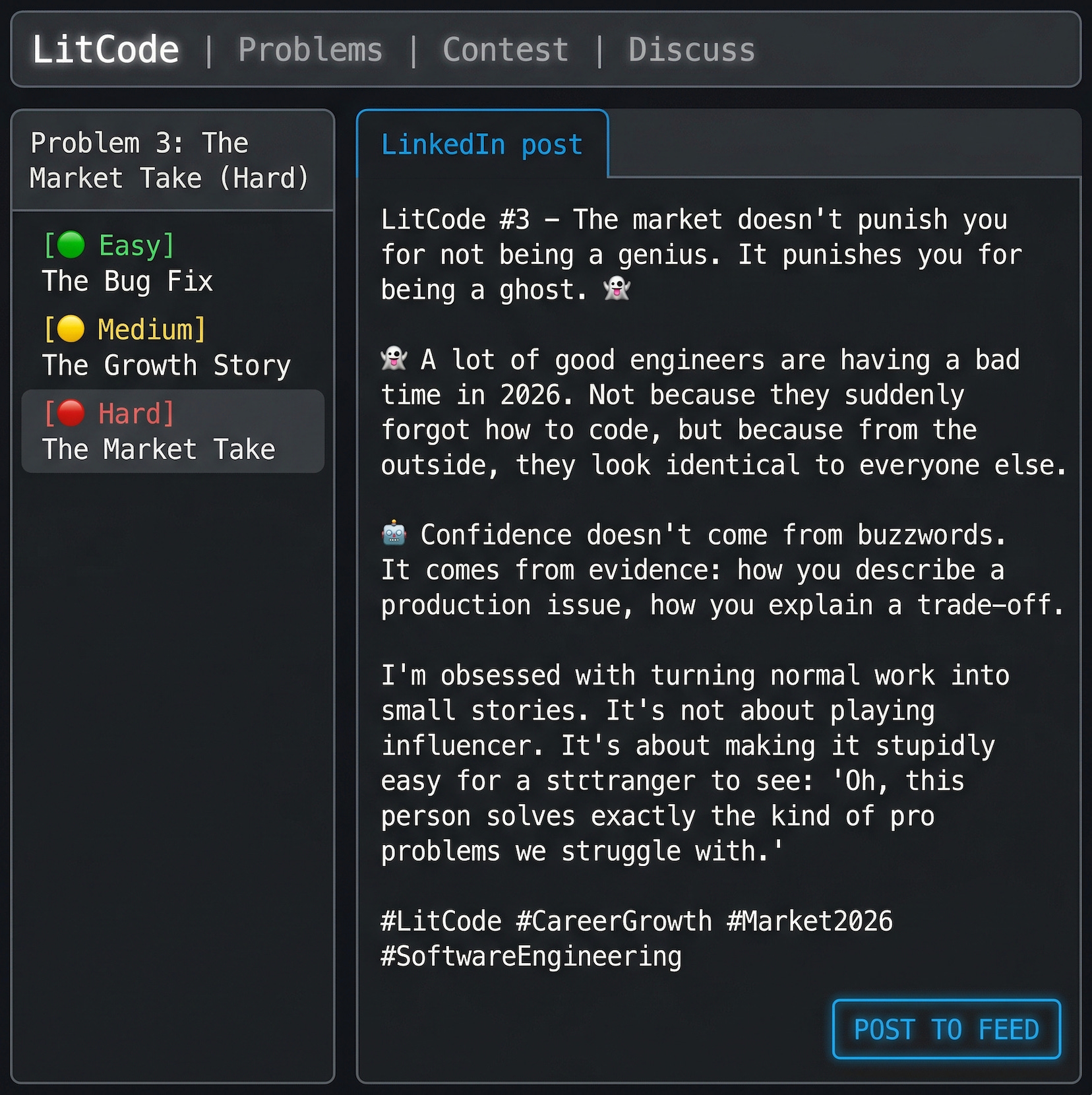
Problem 3 (Hard) – The Market Take 🔴
Now the hardest category:
saying something real about the 2026 market without turning into a rant or a LinkedIn guru.
Topic example:
“Why being ‘good’ is not enough in this market.”
Level 1 – “Complaining mode”
The market is really bad right now.
Companies only want very senior profiles.
It’s hard to stand out when there is so much competition.
Everyone feels this.
But this version doesn’t help anyone.
Level 2 – “Honest but constructive”
LitCode #3 – Being good is not enough in 2026This market is tough, especially if you are “just good”.
Not a genius.
Not a disaster.
Just someone who writes solid code and closes tickets.The problem is that from the outside, “good” looks identical for thousands of engineers.
Same stack. Same job titles. Same keywords.When companies have 200 CVs on the table, they don’t optimise for “fairness”.
They optimise for clarity:
“Who is sending me the clearest signal that they can solve my kind of problems?”That signal rarely comes from your CV.
It comes from the trail of work people can actually see: posts, side projects, talks, even a well‑written bug story.You don’t need to be louder.
You need to be clearer.
Already helpful.
Now let’s push for that “I’d send this to a friend” energy.
Level 3 – “Beats 100% because it’s sharp and kind at the same time”
LitCode #3 – The market doesn’t punish you for not being a genius. It punishes you for being a ghost.A lot of good engineers are having a bad time in 2026.
Not because they suddenly forgot how to code,
but because from the outside, they look identical to everyone else.Same job titles.
Same tech stack.
Same “passionate about clean code” in the bio.When a hiring manager scrolls through profiles, they’re not thinking:
“Who is the smartest person here?”
They’re thinking:
“Who gives me the most confidence that they can handle the problems we actually have?”Confidence doesn’t come from buzzwords.
It comes from evidence:
the way you describe a production issue,
how you explain a trade‑off,
how you talk about results, not only tools.
That’s why I’m obsessed with turning normal work into small stories.
It’s not about playing influencer.
It’s about making it stupidly easy for a stranger to see:
“Oh, this person solves exactly the kind of problems we struggle with.”The market is brutal, yes.
But being invisible in a brutal market is even worse.
No bullets, no generic guru talk.
Just a very clear picture of what’s going on and what you can do.
If you want to practice this:
Take one real bug → write Level 1, then push it to Level 3.
Take one growth moment → again, Level 1 to Level 3.
Take one opinion about the market → same game.
You’ll see that the magic is not in having “cool ideas”.
It’s in doing the refactor step instead of shipping the first draft.