

For twenty years, the definition of a recruiter was simple: a person who reads profiles.
That definition is dead. In 2026, a recruiter is a person who supervises an agent that reads profiles. And that changes what your LinkedIn profile actually is.
It is not a page anymore. It is not a story. It is a record in a database, and every day, thousands of automated queries run against that database. Your profile either matches the query, or it doesn’t exist.
Most engineers I know write their profile like prose, for a human reader who is not coming. Today I want to show you what is actually reading you — and how to write for it.
The agent
Let me give you the facts first, because this is not a vague “AI is changing hiring” take. There is a specific product, with a specific rollout, and you are inside it whether you like it or not.
LinkedIn’s Hiring Assistant — the company’s first true AI agent — reached general availability at the end of September 2025, after a charter pilot that grew to more than 500 companies and 8,000 recruiters. Since then, LinkedIn has been shipping updates in quarterly waves: a February 2026 release, and a mid-2026 “Wave 2” Hiring Release that is rolling out right now, as I write this.
What does the agent do? It takes a job description, extracts the must-have criteria, and converts them into filtering parameters — so the applicant pool is pre-filtered before a recruiter even opens it. It searches. It ranks. It drafts the outreach messages. The February 2026 release even added a Verified Applicant Spotlight, to flag real humans among the flood of fake and AI-generated applications.
And recruiters love it, for one simple reason: LinkedIn reports that pilot users saved more than 4 hours per role and reviewed 62% fewer profiles.
Read that last number again. 62% fewer profiles reviewed.
That’s not “recruiters are a bit faster now”. That means: for every 100 profiles a recruiter used to open with their own eyes, 62 of them are now filtered out by a machine before any human sees them.
The math
Why did this happen? Not because recruiters are lazy. Because reading stopped scaling.
In Q3 2024, applications on LinkedIn jumped 45.5% while the number of jobs posted dropped 10.6%. LinkedIn’s own research from January 2026 says the number of US applicants per open role has doubled since spring 2022. Around 9,000 job applications are submitted on LinkedIn every minute. (source)
Every minute. Nine thousand.
A big part of this flood is AI on the candidate side: people using tools to apply to 200 jobs in an afternoon. So companies answered with AI on their side. 93% of recruiters told LinkedIn they plan to grow their AI use in 2026. It’s an arms race, and the human eyeball lost.
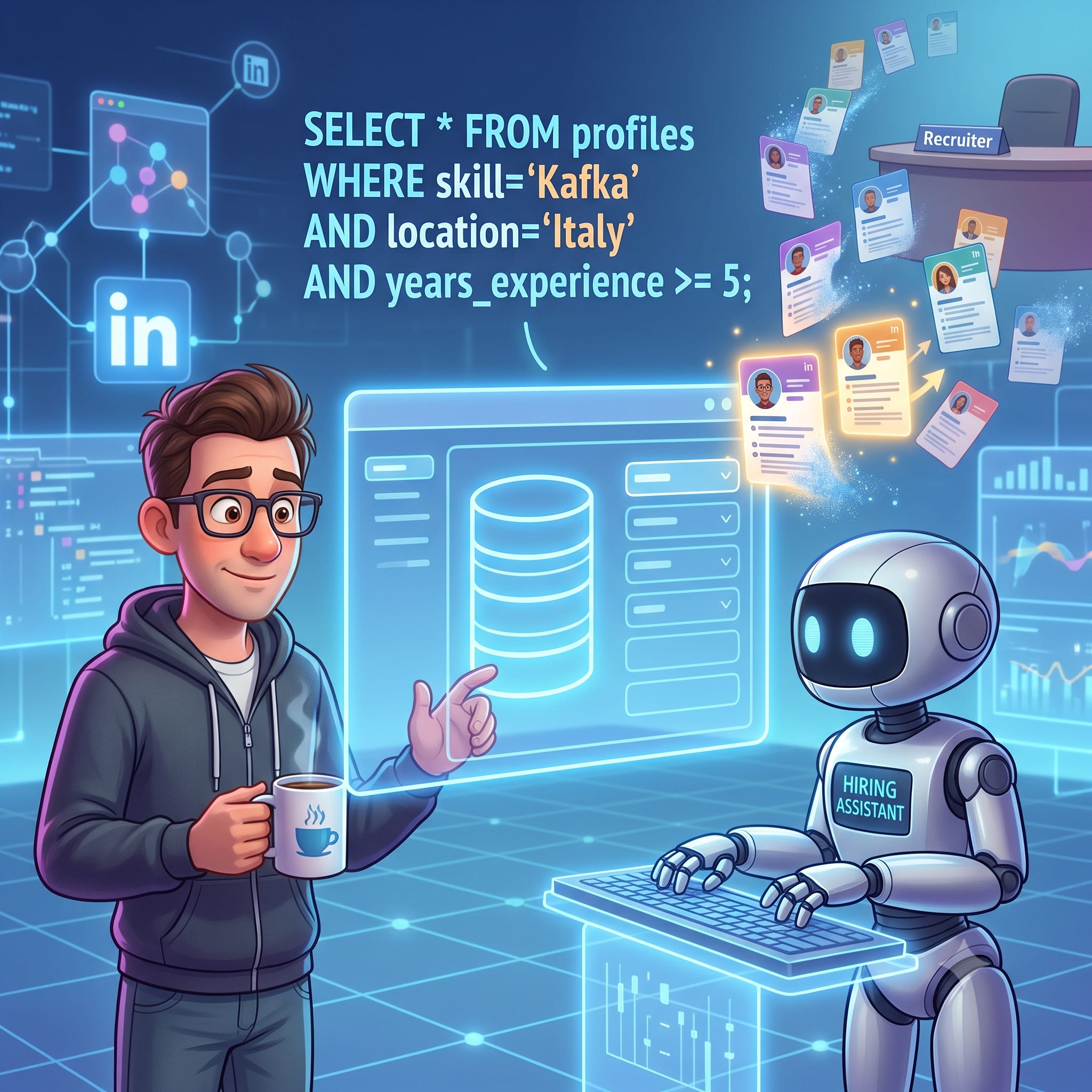
Here is the part that matters for you: when reading doesn’t scale, retrieval replaces reading. A recruiter drowning in 1,000 applications doesn’t read them one by one anymore. They run a query — “backend engineer, Java, Kafka, 5+ years, based in Italy, open to hybrid” — and only look at what comes back.
If your profile doesn’t come back, you were never rejected. You were never retrieved. There is no email, no ghosting, no feedback. Just silence, and you interpreting that silence as “I’m not good enough”.
You are good enough. You are just not indexed.
The query
So what does a query actually match against? This is where being an engineer is a huge advantage, because you already understand this mental model perfectly. You’ve built it a hundred times.
Think of Recruiter search as a system with two stages:
Stage 1 — hard filters. Location, years of experience, current title, skills, open-to-work status. Boolean. You’re in or you’re out. No amount of talent survives a failed hard filter.
Stage 2 — ranking. Among everyone who passed, the AI ranks by relevance: how well your headline, skills, and experience descriptions match the language of the job.
There’s actually a positive twist in this. LinkedIn says 60% of recruiters report that AI is helping them find “hidden gem” talent — people they would have overlooked in a manual search. The machine has no prejudice about your university or whether your last company is famous. LinkedIn’s data even shows candidates without a four-year degree are 10% more likely to get hired when found through these tools.
The machine is, in a strange way, fairer than the tired human it replaced. But only with people who exist in its result set.
Your schema, field by field
Now the practical part. This weekend, do one pass over your profile — not as a writer, but as a database engineer reviewing a schema. Here is each field and what it really is:
Headline → your primary search surface. It’s the most heavily weighted text on your profile. “Software Engineer @ TheFork | Backend | Node.js, TypeScript, AWS” is boring and it works. “Digital craftsman turning coffee into code ⚡” matches exactly zero queries. Nobody types “craftsman” into Recruiter. Put your role, your level, your stack. Personality goes in your posts, not in your primary key.
Skills section → your index. You have 50 slots. Most engineers I review use 9, and half of them are things like “Teamwork”. Recruiters filter directly on this field. Fill it with the real, specific technologies you use: not “databases” but PostgreSQL, not “cloud” but AWS. If it’s not in the index, the query planner never finds the row.
Job titles → use market vocabulary. If your internal title is “Member of Technical Staff II”, nobody queries that. Write the title the market understands — “Backend Software Engineer” — and let the description explain internal details. You’re not lying. You’re translating.
Experience descriptions → name technologies verbatim. “Built a high-throughput event pipeline” ranks worse than “Built a high-throughput event pipeline with Kafka and Go”. The agent matches strings, and a job description says “Kafka”, not “message broker”. Say the actual words.
Location and preferences → the hardest filters of all. Wrong city setting, empty relocation preferences, no work-type selected: each one silently excludes you from thousands of queries. Two minutes to fix, forever.
Open to Work (recruiter-only mode) → an explicit signal. Members using it receive 40% more InMails from recruiters, and the recruiter-only setting hides it from your employer’s eyes. The agent sees intent signals and weights them. Give it the signal.
Total time: maybe forty minutes. Compare that with the hours you spent grinding LeetCode for interviews you never got because the query never returned you.
The stuffing objection
I know what a part of you is thinking, because I thought it too: isn’t this just keyword stuffing? Gaming a dumb system instead of being genuinely good?
No — and the difference is the same one you already respect in engineering.
Keyword stuffing is lying to the index: claiming skills you don’t have, hiding white text, inflating titles. That’s fraud, it eventually explodes in an interview, and by the way LinkedIn is now surfacing verified external signals, like your actual GitHub activity, to recruiters — so the lie has a shorter life than ever.
What I’m describing is the opposite: making true things machine-readable. You already accept this principle everywhere else. You write semantic HTML so browsers parse it. You name variables clearly so the next developer greps them. You’d never say a well-designed API is “gaming” its consumers.
Your profile now has two readers: a machine that decides if you’re retrieved, and a human that decides if you’re interesting. Writing only for the human is like shipping a beautiful website with no HTML structure, just one giant image. Gorgeous. Invisible.
What I found in my own inbox
Last month I did a small experiment: I went back through the recruiter messages I received this year and looked at how they were written.
The pattern was almost funny. A clear majority quoted my profile back to me with suspicious precision: “I saw your experience with TypeScript and AWS…” — the exact strings from my skills section, in the same order. A couple of messages arrived within the same hour, nearly identical, from different companies. These were not humans who stumbled on my profile while browsing. These were queries I matched, and drafts an agent prepared.
Three years ago that would have felt cold to me. Now I read it differently: every one of those messages is a SELECT statement that returned my row. My profile did its job while I was doing mine — writing code, living my life. The machine doesn’t sleep, doesn’t get tired at profile number 400, doesn’t skip me because the previous candidate went to a fancier university.
That’s the quiet deal on the table in 2026. 80% of professionals told LinkedIn they feel unprepared for the job market this year — and I think it’s because they’re preparing for the old game, polishing a story for a reader who has been replaced.
You spend your days writing code that machines execute and humans review. Your profile is now exactly the same kind of artifact.
So here’s your micro-task for tonight, and it takes ten minutes: open your profile and read it the way a parser would. Not “does this sound nice?” but “which queries does this match?” Count the real technologies in your skills section. Check your location settings. Look at your headline and ask: would anyone ever type these words into a search box?
If the answer is no, you finally know where the silence comes from. 👀