

Before AI, coding interviews were already weird.
You were asked to invert linked lists and balance trees while your real job was shipping features, fixing bugs, reading legacy code, and talking to people.
But at least there was one implicit assumption: on the job, you would still have to think and code with your own brain, even if you copied from StackOverflow (by the way RIP StackOverflow).
AI breaks exactly this assumption.
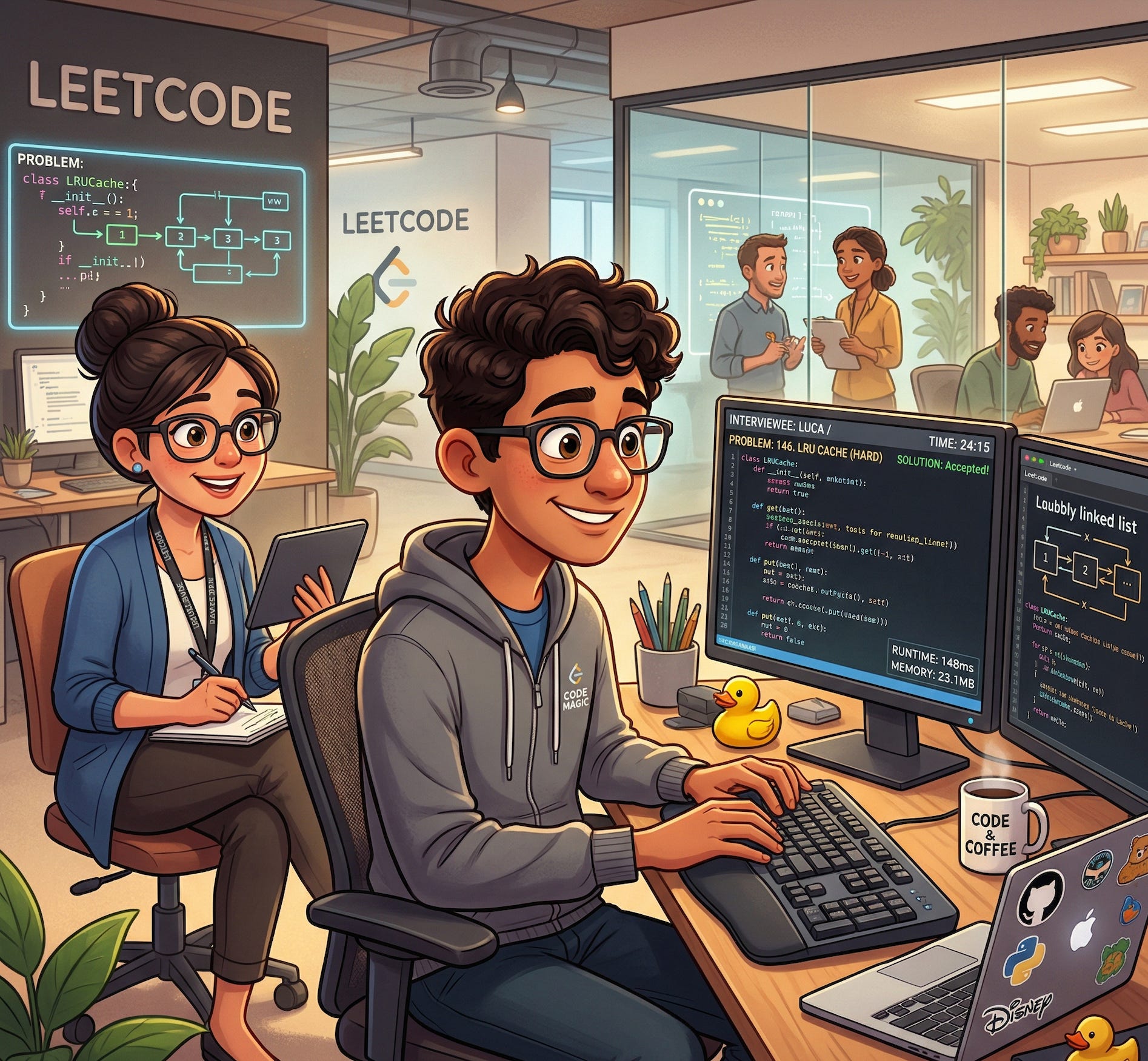
The old contract: puzzles as a proxy for “thinking”
LeetCode-style interviews were always a strong bet on two ideas:
If you pass, you are probably smart enough and can code.
If you fail, it’s “just” a false negative we can live with.
Big Tech knew this was high-precision, low-recall. They explicitly accepted that many good engineers would be filtered out in exchange for fewer false positives.
The problem: even in 2018, many people already pointed out that this format:
Favors people with time and energy to grind puzzles.
Punishes great engineers who don’t optimize their life around brain teasers.
Has almost zero overlap with what you actually do at work.
It’s like judging a marathon runner only by a 100m sprint at 7:30 in the morning and deciding that anyone who is slow at that time of day “does not have the engine”.
Work assignments were a partial fix:
You get a realistic mini-project.
You work with your tools.
Then you explain decisions, trade-offs, and code in a review.
Here the storytelling and the ability to modify your own solution under feedback become as important as the code itself.
What AI really changed (and it’s not just “cheating”)
The big shift is not “AI can now do LeetCode”.
The big shift is that, at work, AI is starting to beat you at the micro-level of code:
Boilerplate generation.
“Straightforward” optimizations.
Translations between stacks and frameworks
Multiple studies already show the tension: using AI speeds up coding a bit, but degrades conceptual understanding and debugging skills if you lean on it too much.
So the job itself is changing:
Less value in being a human compiler.
More value in being the human who guides the compiler.
Trying to interview in 2026 by banning auto-complete, docs, and AI is like hiring a data scientist and forcing them to “prove” themselves with paper-and-pencil matrix multiplications.
Yes, they “can” do it.
But if they do it every day at work, something is very wrong.
Why puzzle interviews become less and less defensible
In this new world, classic coding interviews rest on three assumptions that are no longer safe:
“If you pass my puzzle, you’ll be good at the job.”
“If you fail my puzzle, you probably wouldn’t be good anyway.”
“On the job, you will actually need this exact style of bare-hands problem solving.”
AI erodes all three:
You can now “one-shot” many puzzles with AI tools that exist specifically to do that.
Teams in production rarely write complex algorithms from scratch; they integrate services, reason about systems, manage complexity, and debug AI-generated mess.
Almost nobody codes completely alone without docs, StackOverflow, or AI anymore.
Continuing to run interviews with zero tools while the daily job is “AI pair-programming plus system thinking” creates an insane mismatch.
It’s like banning calculators for a senior accountant interview, when their daily work is 90% ERP systems and Excel.
The hidden risk: skill atrophy and interview inflation
There is another uncomfortable angle:
As more of your real work gets abstracted behind AI suggestions, your raw “by hand” skill will naturally atrophy.
Anthropic’s research shows that people who used AI for a coding task performed worse on a subsequent conceptual quiz than people who coded by hand, even though they had just solved that same type of problem.
So if interview formats stay frozen in the “no tooling, solve this from scratch” era, then:
The average working engineer will get worse at those bare-hands tasks.
Passing the interview will require special training that does not resemble the work.
That means an inflation effect: fewer and fewer normal engineers (who do real jobs with AI) will be able to pass a process that ignores the way real work is done.
Where interviews will have to move
Given all of this, I don’t think coding interviews disappear.
But if they don’t change, they will become a parody.
Here is where they almost have to go. And yes: I think we’ll start to see this transition in 2026.
1. From “can you code?” to “can you supervise?”
Instead of proving you can write everything by hand, interviews will try to measure:
Can you detect when AI code is wrong?
Can you debug and refactor AI output?
Can you keep conceptual control over a large codebase written half by machines?
An interview might look like:
“Here is a feature that an AI assistant implemented for us. Something is off. Find the bug, explain what the AI did, and propose a cleaner structure.”
You’re not racing the AI.
You’re managing it.
2. Work assignments with “transparent AI”
Take-homes won’t die, but they will change rules:
You’re explicitly allowed to use AI.
You must record or describe how you used it. (this will show your explainability skills)
In the review, you walk through prompts, decisions, and corrections.
What they care about is:
Did you blindly accept AI output?
Did you understand the domain?
Can you adjust when requirements shift?
The value moves from “raw typing” to judgement and communication.
3. Interviews that mirror a real workday
Companies that are serious will build interviews that look like a compressed workday:
You get a small backlog, incomplete specs, maybe a bit of messy legacy.
You work with your usual tools: editor, tests, docs, AI.
You ask clarifying questions to a fake “product owner” (the interviewer).
Signals they extract:
Can you slice the problem?
Can you negotiate scope?
Can you say “no” with arguments?
Can you leave the codebase slightly better than you found it?
This is much closer to the “audition” idea many hiring leaders are pushing: it should feel like work, not like a TV quiz.
What to do as an engineer (in 2026, not 2016)
If the real game shifts, your preparation must shift too.
Instead of only asking “how can I get better at LeetCode?”, ask:
How do I think clearly about problems while tools write code?
How do I prove that I can own a feature end-to-end in an AI-heavy world?
How do I show my ability to debug, explain, and make trade-offs?
Practically:
Use AI in your daily projects, but force yourself to explain every non-trivial piece of code it generates.
Keep artifacts of your decisions: docs, ADRs, diagrams, incident write-ups. These will become your “portfolio of judgement”.
When you practice interviews, simulate your actual workflow: editor + tests + AI, and focus on narrating your thinking.
If interviews stay stuck in the past, you will still have to “play the game” sometimes.
But your long-term leverage will not be beating the CPU at puzzles.
It will be becoming the person who tells the CPU what to do, why it matters, and when it’s wrong.
What to do as CTO
If you are a CTO, AI is already changing your company’s daily work.
If you don’t touch your hiring process, it will quietly start optimising for the wrong engineers.
Right now:
Your developers ship with auto-complete, AI pair programmers, and strong tooling.
Your interviews often still ban all of this and test who performs well in a sterile, tool-free puzzle lab.
That gap is your problem to fix, not your recruiters’.
If you keep the old process, three things are very likely to happen:
You filter out exactly the people you need
You’ll reject strong product engineers who are great at supervising AI, understanding systems, and shipping value, because they don’t match an outdated “puzzle athlete” profile.You burn your seniors on low-signal interviews
Your best people will spend hours running ceremonies they don’t believe in, instead of mentoring, designing systems, and building your AI roadmap.You build an org that can’t absorb AI safely
You’ll hire people tested on bare-hands coding, then ask them to manage AI-generated code at scale, with no evidence they can spot when the machine is confidently wrong.
Your job in 2026 is to re-spec what “good engineer” means for your company and then align the interview loop to that spec.
Concretely:
Make interviews look like work: real repo, real constraints, tools allowed, AI allowed, and focus on how candidates drive the tools, not how they suffer without them.
Redefine your signals around judgement, communication, system thinking, and ability to debug and refine AI output, instead of raw typing speed or memorised tricks.
Protect senior time: automate or outsource the low-signal early filters and keep your best engineers for the conversations where they can actually recognise future teammates.
Close the loop: measure which interview signals correlate with performance after 6–12 months, and be ruthless in deleting formats that don’t predict anything.
If you don’t do this, you won’t just have “annoying” interviews.
You’ll have a hiring system that is perfectly tuned to find engineers for a job that no longer exists.