

In December, IT Brew ran a piece asking: “Will 2026 be the year of the forward-deployed engineer?” and backed it with one crazy stat: job postings for this role have multiplied by around 5x in a single year, with some sources even talking about +800% growth in 2025.
A few days ago, a LinkedIn News brief updated the picture: demand for forward-deployed engineers jumped by roughly 1000% in 2025, but many engineers still ignore these roles because they see them as “grunt work”, less prestigious than classic product engineering.
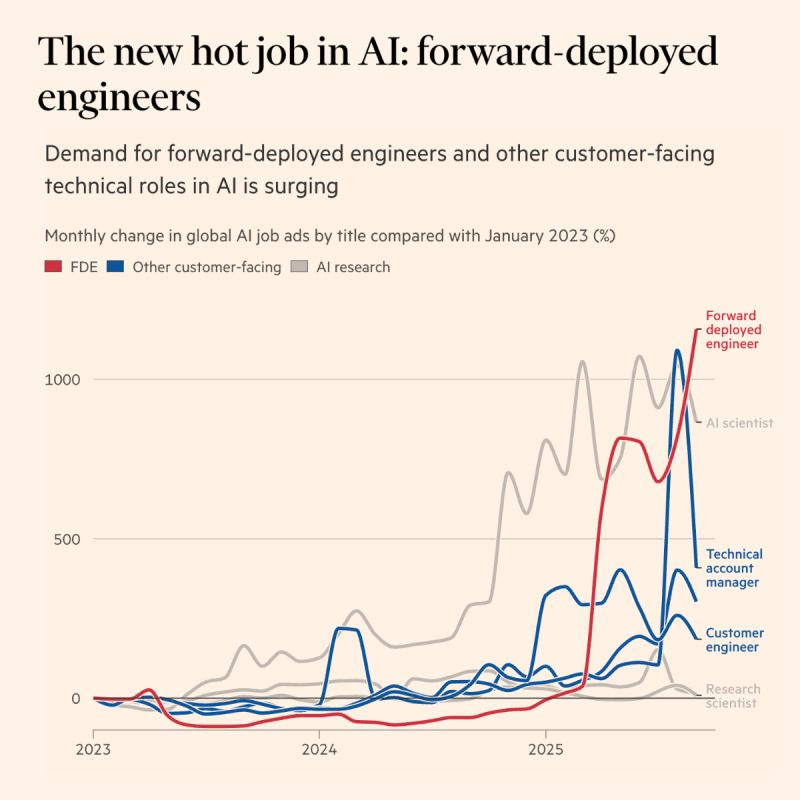
So we have a role companies are screaming for, that most devs either don’t really understand… or actively avoid.
Perfect topic for The LinkedIn Engineer.
So, what is a Forward-Deployed Engineer?
Strip away the buzzword.
A Forward-Deployed Engineer (FDE) is a software engineer who sits in the field, close to customers or business teams, and ships custom solutions on top of an existing platform (often AI) to solve very specific problems.
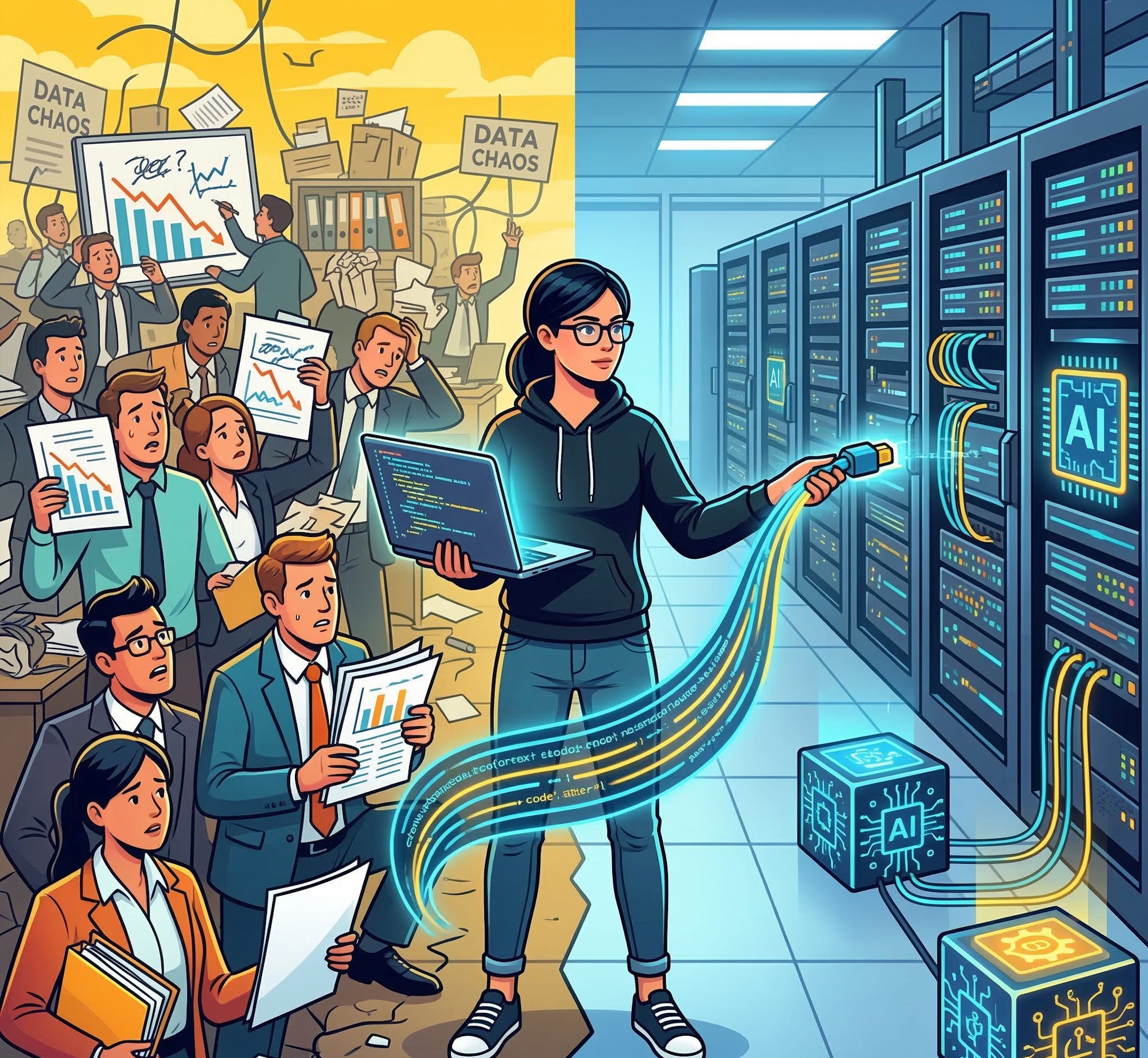
Instead of building a generic feature for “millions of users”, you go deep on one client, one business line, one messy workflow… and you make the system actually work in real life.
You are half builder, half translator.
You speak code, but you also speak “we are losing money here every day”.
Why is it suddenly everywhere?
Context is simple: in 2025, AI moved from demo mode to production for a lot of companies.
They now have powerful models and platforms, but almost no idea how to plug them into legacy systems, dirty data, and political process mess.
They don’t want:
a researcher who only writes papers
a consultant who only writes slides
a support engineer who only closes tickets
They want someone who:
embeds with the client
understands the real problem
builds the PoC
hardens it
gets it running in their infra
and brings learnings back to the product team.
This end-to-end loop is exactly how FDEs describe their work at AI-first companies like OpenAI, Anthropic, Palantir and others.
The day-to-day (without the fluff)
Let’s drop the marketing.
A typical FDE cycle in 2026 looks like this:
You get a vague business request
“We want to use AI for customer support” or “We need to reduce fraud.”You turn it into a concrete problem
You sit with operators, read logs and dashboards, find the real bottleneck, and design a clear technical plan.You build a PoC
You code fast: scripts, integrations, agents, pipelines. It’s rough, but it proves value.You ship it for real
You refactor, add observability and guardrails, deal with infra constraints, security, and compliance.You close the loop
You see patterns across different clients and feed them back into the core platform, so the product evolves based on what you saw in the field.
It’s not a “talking” role.
You still have hands on keyboard.
The difference is that your backlog is written in business pain, not just in JIRA tickets.
Is it just a fancy “customer-facing engineer”?
A lot of senior voices are openly saying: “Forward-Deployed Engineer is just a new label for what devs should have been doing anyway: talking to users and working with the business.”
And they are not totally wrong.
XP and Agile have been telling us for years that developers should be close to the problem, not just to the repo.
What is new:
The AI angle: you are often the one who makes LLMs and agents safe, observable, and actually useful in production.
The role fusion: instead of separate solution architect, data scientist, and customer success, the FDE often replaces two or three of these profiles at once.
That is why FDEs are becoming one of the better-paid profiles, and why job postings exploded between 2024 and 2025.
Why many engineers still run away
Even with all the hype, early 2026 data is clear: demand is exploding, but engineer interest is much softer.
Common fears you hear:
“This is just firefighting for demanding clients.”
“I’ll end up doing support, not engineering.”
“I’ll lose technical depth and become the person for calls.”
In some companies, that risk is real.
If the culture is “the customer is always right”, you get random requests, 10 PM calls, and no real product ownership.
So you need to filter these roles aggressively, not accept them blindly.
When an FDE role makes sense for you
You should at least keep an eye on FDE roles if:
You are already “that person” in your team
You are the dev PMs and sales pull into calls because “you explain things well”. You get pinged to unblock weird prod bugs with half the info, and you still deliver.You like product, not only code
You care about why something matters, not just how to implement it. You ask “what metric are we moving?” before you open the editor.You are curious about AI systems
Many FDE roles now sit between infra, data, and AI agents. You don’t have to be a researcher, but you must be comfortable with evals, guardrails, monitoring, and real integrations.
If that sounds like you, this role can be a career accelerant, not a weird side quest.
Because you learn exactly what the 2026 market pays the most for: turning advanced tech into measurable business impact.
How to position yourself (starting today)
Even if you don’t apply to an FDE role tomorrow, you can start acting like one now.
In your current job:
Volunteer to join at least one non-technical stakeholder call per month.
Take one vague request and drive it end-to-end: clarify, design, build, ship, measure.
Document the before/after with concrete numbers, not just “refactored X”.
On LinkedIn and your CV, skip “implemented feature X”.
Write like an FDE:
“Reduced manual review time by 40% by building Y for the operations team.”
“Deployed Z to production in 6 weeks, integrating 3 teams and 2 legacy systems.”
You are still showing Proof of Work, but now it is directly tied to revenue, cost, risk, or time.
That is exactly what hiring managers for FDE roles are scanning for in 2026.
If you are already doing this, you might be closer to “Forward-Deployed Engineer” than you think.