

In 2026, the act of "writing code" has been almost entirely outsourced to machines. If your day-to-day value is still tied to your ability to manually type syntax, you are effectively obsolete.
Competing purely on your ability to write syntax is a losing game.
It is exactly like early blockchain mining. Trying to out-code an AI today is like a single computer trying to win a race against a global network of ASICs. You are competing against infinite, instant compute. You cannot win on speed. You cannot win on volume. And very soon, you will not win on accuracy either.
As AI takes over the execution layer, the amount of manual code we write drops dramatically. This change has created a massive, silent crisis across the industry. The true victims are not the managers, the directors, or the tech leads. The true victims are the current Juniors.
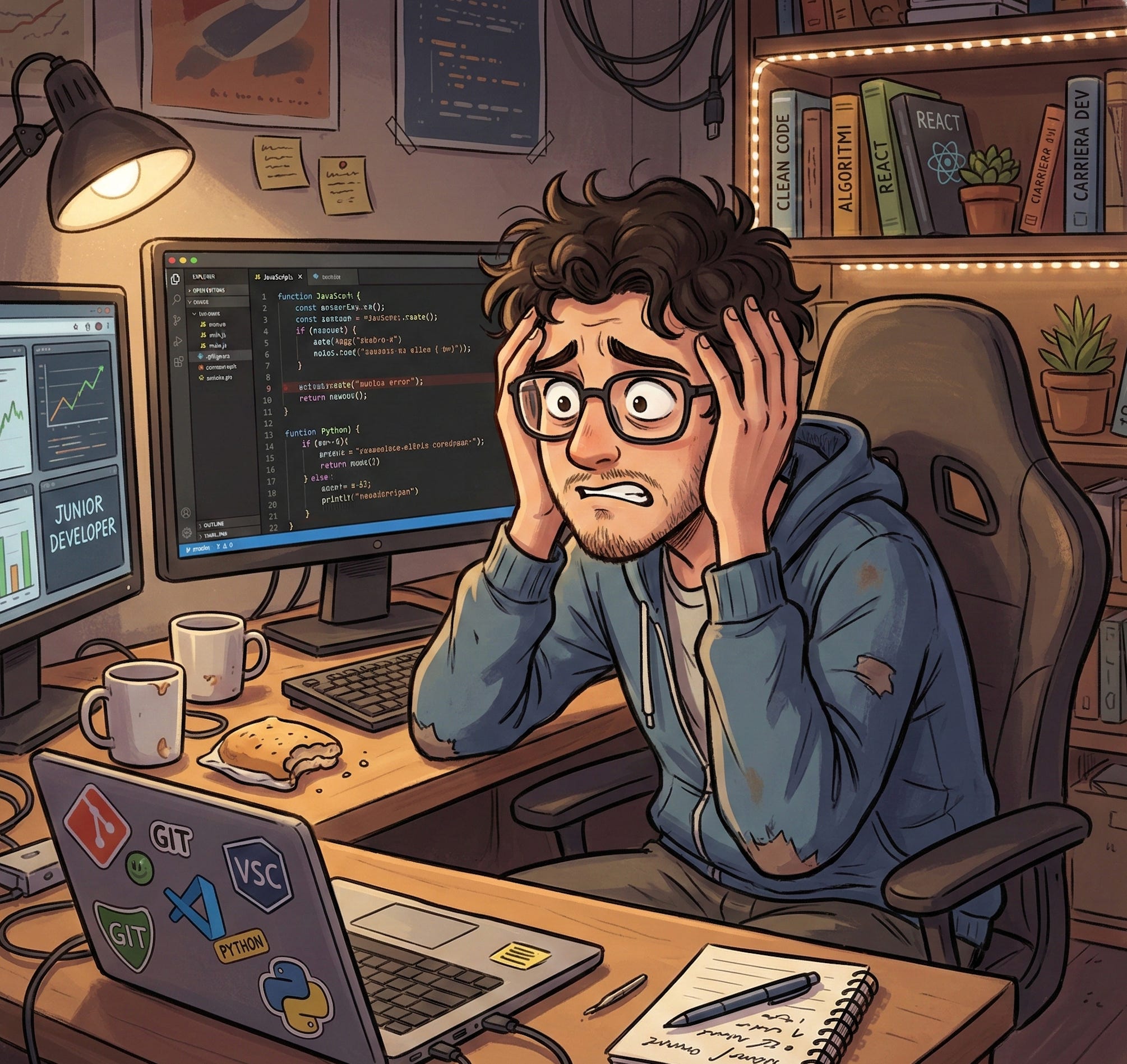
The Paradox of Friction
If the AI does the heavy lifting, a terrifying problem emerges at the base of the industry.
Historically, you learned to program through hard work and frustration. You learned about database locks because you accidentally crashed production at 3 AM and had to fix it while sweating over your keyboard. You learned memory management by staring at broken code for three days straight.
That friction was how you learned. That intense struggle is exactly what built the mental models you needed to understand complex systems. You did not just learn the syntax. You learned how the machine actually works.
If AI removes the friction, how do you learn? If an agent instantly hands you the perfect function, you get the output, but you lose the journey. You lose the struggle that makes you a true engineer.
This leads to a chilling question.
In ten years, will we still know how to build software?
If nobody is forced to sweat through the logic, an entire generation will forget the technical details behind the tools they use. We risk becoming operators who simply talk to black boxes we fundamentally do not understand.
The Luckiest Generation
This exposes a brutal unfairness in the current market. The last generation of Senior Developers hit the jackpot.
They built their careers before the AI boom. They were forced to endure the manual labor of software engineering. They accumulated years of painful problem-solving. Now, at the peak of their careers, they have been handed the ultimate multiplier. They can use AI to 10x their output because they possess the deep, hard-earned knowledge to steer it, architect around it, and fix its mistakes.
Or at least, until they forget how to code too. Because if you stop exercising a muscle, it gets weak. Even Seniors risk losing their edge if they blindly trust the output.
But the Juniors are stranded. The traditional entry-level job is gone. Nobody will pay a recent graduate a salary to write boilerplate code, fix minor CSS bugs, or build simple CRUD endpoints. The AI does that for free, instantly.
The 9 skills you should have if you are a Junior in 2026
So, what do you do? If the "junior coder" role is dead, how do you enter the market? You must completely pivot. You must stop competing on syntax and start competing on reality.
Here is your new baseline. These are the 9 concrete skills you must master to survive and grow.
1. Reading is the new Writing You will not be hired to write 10,000 lines of code. You will be hired to review them. In a Spec-Driven Development environment, your role shifts dramatically: you must review mountains of technical specifications and outputs before the code even begins to exist. Your job is to "spot the lie". You must develop a ruthless ability to read through complex logic, identify broken business rules, and find security vulnerabilities in seconds. If you want to maintain control over the system, you must be a world-class reader. If you can’t validate the spec, you can’t own the product.
2. Connect the Dots AI is incredibly good at local solutions. It is terrible at global thinking. It will write a perfect isolated function that completely destroys your database architecture when deployed. Your job is to see the whole board. You must understand how the frontend affects the backend, how APIs interact, and how data flows. You must become a systems architect from day one.
3. Master System Design AI can easily generate a perfect software architecture. But it will be a generic one. AI does not know the messy reality of your company. It does not know the decisions made in meetings or the hidden human variables. Every architecture must fit the exact system you are working on. You must develop a holistic view to gather all this real-world context in your mind. Your job is to understand the whole picture so you can give the right constraints and the exact context to the AI.
4. The Art of Asking Questions In the AI era, the world is divided between those who get results and those who don't. The difference is rarely technical—it’s the ability to ask the right questions. Socratic questioning and critical thinking are your new "IDE". Asking the right question is how you express deep thought and force the AI (and yourself) out of generic patterns. This is the ultimate human advantage: AI can answer anything, but it cannot decide what is worth asking.
5. The Human Problem As Tom DeMarco and Timothy Lister established in the classic book Peopleware, most problems in software development are not technical. They are human. AI does not understand office politics. AI cannot read the room when a stakeholder is angry. AI cannot negotiate a feature cut with a stressed Product Manager. If you can mediate between cold code and messy human emotions, you become essential.
6. Deep Domain Expertise The AI knows Python perfectly. The AI does not know the specific business rules of the logistics company you work for. You must become obsessed with the real-world domain. Understand the business model, the costs, and the user’s pain points. If you hold the context of the business, you hold the power to direct the technology.
7. Cross-Disciplinary Translation The walls between departments are falling. You can no longer just speak "developer". You need to speak "design" to the UX team, "revenue" to the sales team, and "strategy" to the founders. You must become the translator who connects the business goal and the technical execution.
8. Be Innovative AI only follows instructions. It does not wake up and decide to improve the product. You must become a promoter of bottom-up approaches. Do not just sit and wait for the next task. Be proactive. Look at the business, find hidden problems, and propose new ideas to solve them. Suggest new approaches that add real value to the project. This human initiative is something no machine can replicate.
9. Cultivate your Infinite Context Window An AI agent might have a huge context window, but it does not live in the real world. Your human context window is infinitely larger. You can accumulate context for months and years. When you take deep ownership of a product, you naturally become a central hub. You remember why an architecture was chosen three years ago. You know which client requested a weird edge case. You accumulate years of unwritten rules and team decisions. If you actively manage this historical knowledge, you become irreplaceable. You become the living memory of the company.
If you are a Junior reading this
The traditional ladder is broken, but you do not need it anymore.
In practice, you are now required to work on the exact skills that a Senior developer used to start acquiring only after years in the field. You lost the luxury of easing into this career by writing meaningless CSS and boilerplate. But you also gained the ability to operate at a level that used to take a decade to reach. You get to skip the typing phase and go straight to the thinking phase.
Stop waiting for a Senior to hand you a perfectly written ticket. Stop hiding behind the code editor. Go find a messy business problem. Use AI to do the heavy lifting, and use your brain to make sure it actually works in the real world. Take full ownership of the final result.
The market will never again pay for a junior typist. It will only pay for a junior problem solver.
The friction has not disappeared. It has just moved from the syntax to the system. The syntax belongs to the machine. The system belongs to you.