

There is a massive restructuring happening in the tech industry right now. We see it every week in the headlines. Massive corporations are executing brutal layoffs. They are not just cutting costs.
They are waking up to a terrifying realization: their entire workforce was architected for a completely different industrial epoch.
They built armies of specialized workers to solve the friction of building software. That friction is now gone.
This sudden shift has created a pervasive fear of replacement. Developers are terrified that AI will simply delete our profession and leave us jobless. I look at the market data and see a very different trajectory. We are not facing mass unemployment. We are facing a radical mutation in our degree of diversification.
We are heading toward the "1-man company" hypothesis. Instead of being replaced, we will become fractional entities. We will mutate into "fractional software engineers" who sell specialized orchestration to multiple employers, startups, or even other 1-man companies.
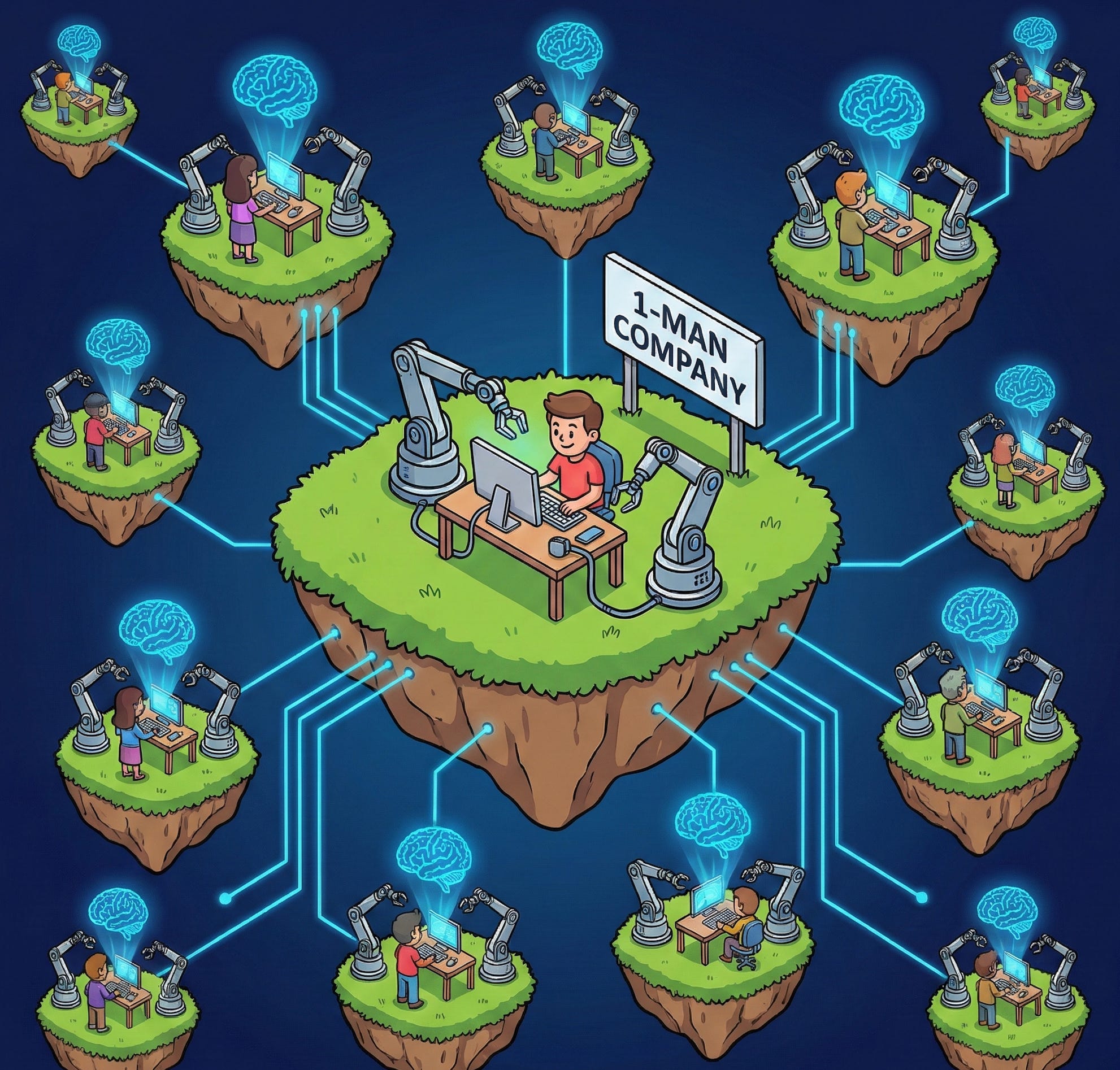
The Inversion of Risk
To understand why this is happening, we have to look at how the concept of professional risk has completely flipped.
A decade ago, a full-time, open-ended contract was the ultimate guarantee of safety. Freelancing was viewed as a chaotic, high-risk gamble. Today, that logic is fundamentally broken.
A traditional full-time job is a single point of failure. You are a business of one, selling 100% of your inventory to a single client who can terminate your revenue stream on a Tuesday morning via an automated email. That is a catastrophic risk management strategy.
Paradoxically, the freelancer model is becoming the safer harbor. Having five different clients paying you for fractional work allows you to diversify your risk. If one startup goes under, you lose 20% of your revenue, not 100%. Operating as a 1-man company is rapidly becoming the only rational way to hedge against corporate volatility.
The Evaporation of the Middle
This fractional shift is creating an hourglass market. The middle layer is completely evaporating.
Companies are aggressively flattening their hierarchies. They are actively eliminating intermediary roles like traditional Product Managers and Engineering Managers. They no longer want a chain of command to translate business needs into code. They want deep transversality. They demand Product Engineers and Technical Leaders who can touch the database, understand the unit economics, and ship the feature autonomously.
We see this in the startup ecosystem too. The old rules are dead. Previously, a startup would reach Product-Market Fit and immediately hire 200 people to scale operations. That era is over. Today, highly successful companies hit massive scale and actively choose to remain incredibly lean. They scale revenue, but they freeze headcount. The market simply has no room for the corporate middle class anymore.
The Three Digital Drivers
This transition into an army of 1-man companies is accelerated by three fundamental forces in the digital world.
1. The Dev as an Agency A software engineer is no longer just a typist of syntax. Armed with AI models, a single developer can act as an autonomous agency. You can generate the marketing copy, design the UI, write the complex backend logic, and analyze the user data. The developer is no longer a cog in the machine. The developer is the machine.
2. Democratized Infrastructure The barrier to entry has collapsed. Cloud computing, API ecosystems, and global payment gateways like Stripe have driven the cost of launching a digital product to near zero. Capital is no longer the bottleneck for creating software. The only true limit remaining is capturing the market’s attention.
3. The Redefinition of Security As mentioned, the math of safety has changed. The infrastructure allows you to serve multiple nodes simultaneously. You can build micro-SaaS products while consulting fractionally for a Series A startup. You own your means of production.
The Biological Ceiling
If the economics of the 1-man company are so superior, why won’t every single person adopt this model? Humans do not scale like software.
True entrepreneurship requires a tolerance for chaos, financial instability, and chronic stress. The burnout rate for solopreneurs is brutal. Taking full responsibility for every failure is a psychological burden that most people actively want to avoid.
Furthermore, we are strictly bound by the 24-hour limit. No matter how much AI leverage you deploy, you eventually hit a ceiling where growth requires delegating to other human beings. This is an absolute rule for "Deep Tech". You cannot build a quantum computer, cure complex diseases, or launch a fusion reactor from your bedroom. The deepest innovations still require massive capital, complex human friction, and multidisciplinary teams.
Crossing the Physical Chasm
So far, the 1-man company model has been restricted entirely to the digital world. SaaS, media, and consulting are playgrounds of pure information. A tectonic shift is coming.
What happens when robotics gets its ChatGPT moment? What happens when Embodied AI becomes cheap, reliable, and accessible?
We will witness the birth of the 1-Man Orchestrator. Imagine a former software engineer who no longer deploys code to AWS servers. They deploy instructions to a swarm of autonomous drones, automated forklifts, or robotic manufacturing arms.
This will create true "Micro-Multinationals". These will be companies consisting of two or three individuals. They will coordinate physical fleets via software APIs and generate the physical output of a 1990s manufacturing plant. The bridge between digital logic and physical atoms is being built right now.
Hardware Forgives No One
Before we crown ourselves the kings of robotic empires, we must acknowledge the brutal laws of physics. Software costs 20 dollars a month and scales infinitely. Atoms are heavy, expensive, and unforgiving.
If you want to orchestrate physical labor, you will inevitably hit three massive walls.
First, the Capital Wall. Hardware requires serious money. Software needs electricity. Robots need steel, lithium, physical maintenance, and massive upfront CapEx. You can bootstrap a web application over the weekend. You cannot bootstrap a fleet of delivery robots without millions in funding.
Second, the Liability Wall. If your web application has a bug, a database drops and you lose a few customers. If your autonomous robotic arm has a bug, it might crush a warehouse worker. You will go to prison. The physical world demands rigorous compliance, safety protocols, and massive insurance policies. You will need a heavy, structured corporate shield just to absorb the legal liability of moving atoms.
Third, the Supply Chain Wall. Moving physical goods is not like routing data packets. Physical production relies on incredibly complex, slow, and heavily guarded oligopolies. Ports, shipping routes, and raw material extraction are controlled by massive entities. You cannot disrupt a cargo ship with a Python script.
The Orchestration Era
Five years ago, the theory of the "1-man company" orchestrating both digital and physical empires sounded like an extreme cyberpunk fantasy. It was an improbable thought experiment. Today, the contours of this reality are becoming incredibly concrete.
It is completely normal to feel disoriented. The death of the corporate middle class, the brutal layoffs, and the rise of AI agents create a deeply uncertain environment. But we must not confuse uncertainty with doom.
This is actually a message of massive hope. We are living through the most empowering time in human history to be a builder. A single individual has never wielded this much raw leverage. The fact that the old corporate safety net is vanishing also means that the old corporate ceilings are gone.
Code might be becoming a commodity, but human ingenuity is not. We are stepping into a chaotic, unmapped territory. But the potential on the other side of this transition is absolutely massive.
Remember that the most powerful technology ever to exist still has absolutely no rivals. It is human intellect and its ideas. The creative and decision-making process remains firmly in human hands.
In the future, what will matter is not being an engineer. What will matter is being smart, being organized, and being innovative.
And none of that depends on the technology.
Finally a good, balanced and not hyped article about 1-man companies
Good job Giovanni! :)
Btw, what I'm most interested in are the possible consequences of this shift on the policy maker. Having more and more 1-man companies at scale will probably condensate wealth into few hands. Also the social and fiscal policies will need to be fine tuned and I'm really interested about it, because I cannot image how it could be done 😅