

About 10 months ago, I published this exact thought on LinkedIn:
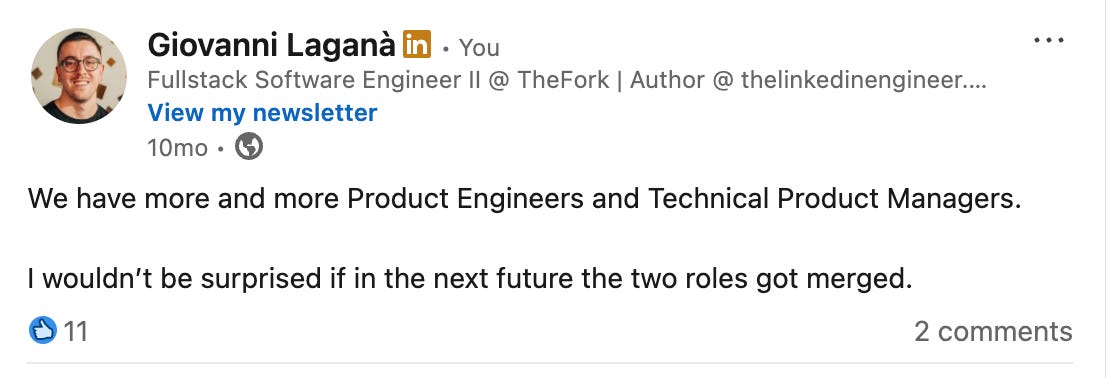
When I wrote it, it sounded like a mild provocation. Fast forward to today, and it is no longer a prediction. It is a survival strategy.
We are living in an era of massive uncertainty for tech workers. Layoffs have reset the market, AI agents are writing boilerplate faster than we can type, and the classic “Software Engineer” role is experiencing an identity crisis.

If you are wondering what your next career move should be, the answer is not learning another JavaScript framework. The answer is stepping out of the code and into the product.
1. What exactly is a “Product Engineer”?
Let’s clear the confusion immediately: a Product Engineer is not just a Full-Stack developer with a trendy new title. It is a fundamental shift in ownership.
A traditional Software Engineer is measured by Output. They receive a well-defined Jira ticket, they write the code, they pass the tests, and they close the ticket. Their concern is how to build it.
A Product Engineer is measured by Outcome. They care about the business metrics. They care about user retention, churn, and revenue. Their primary concern is what to build and why we are building it.
A Product Engineer is an engineer who has the technical chops to ship a feature end-to-end, but the business acumen of a Product Manager. If a requested feature makes no sense for the user, they push back before writing a single line of code.
2. How did we get here? A brief history.
To understand why this role exists, you have to look at the evolution of abstraction layers in our industry.
Phase 1: The Silos (2010s). We had strict boundaries. Frontend devs wrote HTML/CSS. Backend devs wrote Java. DBAs touched the database. Sysadmins deployed. It took 5 people to ship a button.
Phase 2: The Full-Stack & DevOps era (2015-2022). Cloud infrastructure (AWS, Vercel, Supabase) abstracted the servers away. Frameworks evolved. Suddenly, one engineer could build and deploy the entire technical stack.
Phase 3: The Product Era (Now). The technical barriers to entry have collapsed entirely. We have solved the problem of how to build software quickly. The new bottleneck is deciding what is actually worth building.
We reached a point where companies realized they were extremely efficient at shipping code that nobody wanted. The gap between “the person who talks to the user” (PM) and “the person who builds the thing” (SWE) became too expensive. So, the roles began to merge.
3. The 2026 Reality: Why you must become one right now.
Why is this transition so urgent? Because the value of pure, raw “Hard Skills” is deflating rapidly.
Let’s be brutally honest: if your only professional skill is translating a perfectly written set of requirements into TypeScript or Python, you are in danger. You are competing directly with AI models that do exactly that—translation of intent into syntax—for pennies, instantly, and without complaining.
Syntax is becoming a commodity. Writing code is no longer the scarce resource.
AI cannot talk to a frustrated customer on a Zendesk call, understand the nuanced reason why they are abandoning the checkout flow, and intuitively prototype a UX fix that aligns with the company’s revenue goals. A Product Engineer can.
4. The rise of the Micro-Team and Solopreneurs
There is another massive macroeconomic trend pushing this: the rise of Lean Startups, Product-Led Growth (PLG) companies, and Solopreneurs.
Capital is no longer free. Startups cannot afford the bloated teams of 2021, where every feature required a PM, a UX Designer, an Engineering Manager, and three devs. Today, the most successful tech companies are incredibly lean. They want Micro-Teams: 1 or 2 highly leveraged Product Engineers who can iterate directly with the market.
If you are a Solopreneur or an indie hacker, you already know this. You are forced to be a Product Engineer because you don’t have a PM to write your specs. You have to figure out the market fit yourself. Companies are now looking for this exact “founder mentality” inside their own ranks.
5. How to make the switch (and what to stop doing)
You don’t become a Product Engineer by asking your HR department for a title change. You become one by fundamentally changing how you operate on a daily basis.
If you want to survive this shift, you have to kill the “Ticket Taker” mindset. Here is how you operate now:
Stop worshipping clear requirements: If you only thrive when someone hands you a perfectly groomed specification, you are vulnerable. The market doesn’t pay a premium for execution anymore. Be the one who puts clarity on ambiguity. Take a messy, unstructured business problem and define the technical path forward yourself.
Talk to the stakeholders: You are the bridge. Right now, you are the crucial intermediary between the real-world and the technology. You need to step out of your IDE and understand the constraints of the business, the goals of the founders, and the dynamics of the market. When you hold the context of the real world, you dictate how the technology should serve it.
Look at the damn metrics: You cannot care about the product if you don’t know how it’s performing. Get access to your analytics tools. If you deploy a feature and never check if users are actually engaging with it, you are still just a coder.
Prioritize “Time to Value”: Building the perfect, scalable architecture for a feature nobody wants is a massive waste of time and money. A Product Engineer ships fast to validate the idea, and refactors later when the market proves them right.
Conclusion: Start to focus on Context
We have already entered a transition phase. With AI writing the bulk of our code, the true added value of a developer has shifted. You are no longer just writing software, you are Engineering the Context.
Yes, you still need to make the effort to stay in full control of the AI-generated code. You cannot afford to blindly trust the black box and lose your grip on the architecture. But while you maintain that control, you must restructure how you work.
Your goal is no longer to be a “coder”. Your goal is to be organized, smart, and deeply connected to the real world.
AI has the syntax, but it has no memory of what actually happens outside your IDE. Your new job is to remember the details, connect the dots between user problems and technical solutions, and stimulate the creativity that algorithms lack.
These are the new hard skills. Stop focusing on syntax. Start focusing on context.