

Let’s start with the basics.
A cover letter is a short document you attach to a job application, alongside your CV. Its purpose? To introduce yourself, explain why you’re applying, and add some context that a resume alone can’t convey.
For a long time, it was considered mandatory. A non-negotiable step. You applied. You attached the CV. You attached the cover letter. That was the formula.
But in 2026, things are more nuanced — and if you’re a Software Engineer, you’ve probably asked yourself at some point: do I even need to bother?
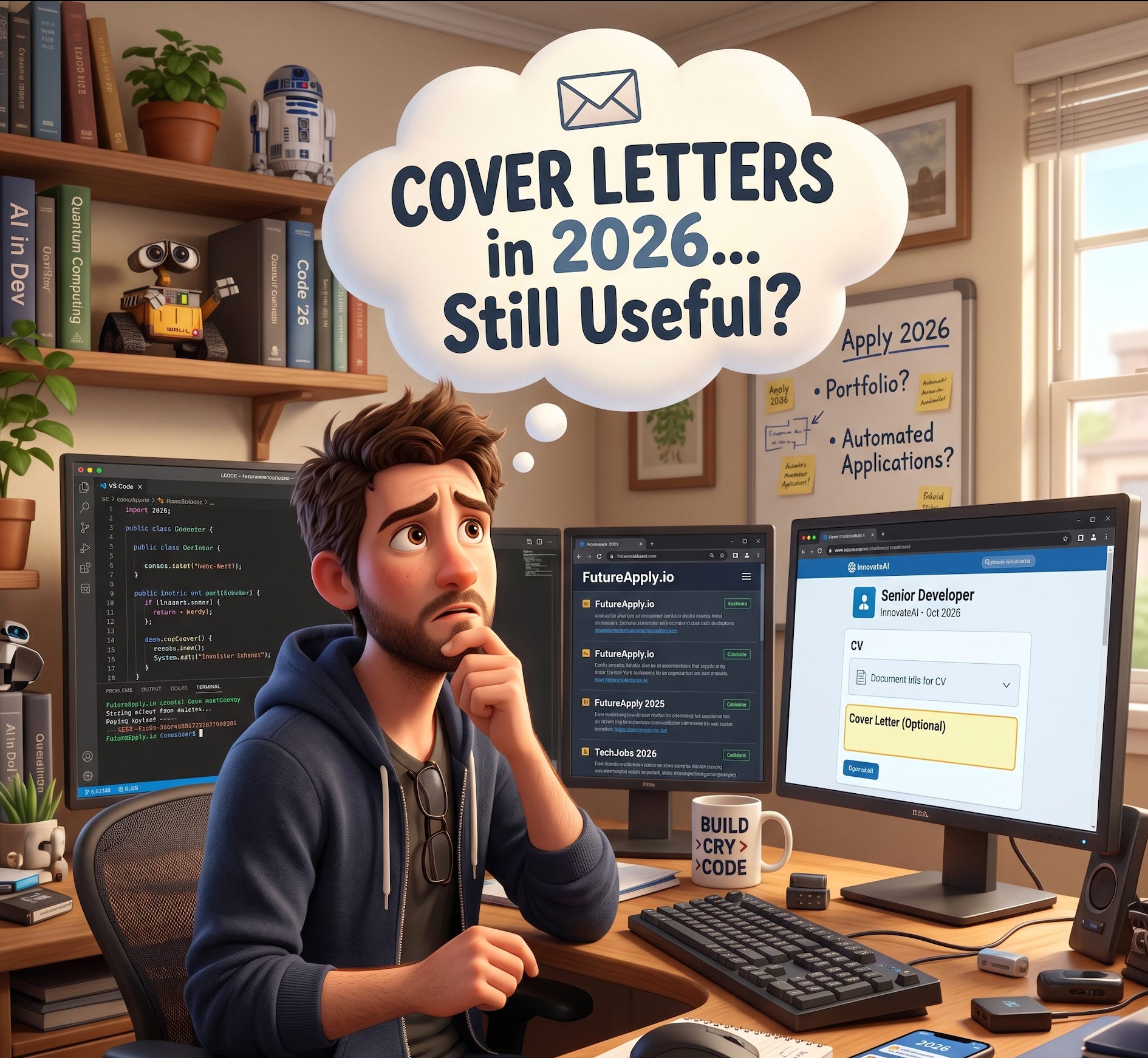
The AI elephant in the room
Here’s the honest question most people are thinking but few say out loud:
Now that I can open ChatGPT and get a perfect cover letter in 30 seconds, what’s the point?
And it’s a fair question.
Historically, one of the things a cover letter was supposed to demonstrate was your ability to write — your command of the language, your communication skills, your professionalism. If you were applying for a role in an English-speaking company and your first language wasn’t English, a well-written cover letter was a subtle but meaningful signal.
But now? Anyone can produce a polished, grammatically flawless letter with a simple prompt. The playing field has been leveled — or more accurately, it’s been flattened.
So if everyone can write a perfect cover letter, does it still mean anything?
What the cover letter is actually for now
Here’s my take: in 2026, the cover letter is no longer an exercise in style. It’s no longer about demonstrating that you can write well in English.
It’s your chance to tell your story — without being constrained by the brevity of a CV.
Think about it this way.
When you’re fresh out of university, a cover letter feels like torture. You have almost nothing to put in your CV, so you write a cover letter to compensate — to say “yes, my experience is thin, but here’s who I am and why I’m motivated.”
But something interesting happens a few years later. Once you reach 3 or 4 years of experience, the problem flips. Suddenly, you have too much to say. You’ve worked on multiple projects, navigated different tech stacks, led initiatives, made mistakes, learned things the hard way. And a CV — by definition — forces you to prioritize.
You’re compressing your career into bullet points. You pick the top three things from each role. You cut everything that doesn’t fit on two pages. You’re constantly choosing what to leave out.
And when you leave things out, you lose the story.
The CV tells what. The cover letter tells why.
Your CV is a list. A clean, structured list of what you’ve done. Dates, companies, roles, technologies.
It doesn’t have room to explain:
what actually drove you to make a particular career move
what you believe about how great software should be built
what energizes you when you wake up in the morning
why this specific role makes sense for where you’re heading
A cover letter gives you that room.
And when you’re mid-career, that space becomes genuinely valuable — because the things that set you apart are often not the things that fit in a bullet point. They’re the context around the bullet points.
What recruiters actually do when they open your application
I’ve been on the receiving end of hundreds of job proposals — and I’ve also spent time talking to people who review applications for a living. And the pattern is remarkably consistent.
The CV comes first. Always. It’s faster to scan, easier to filter, and most of the hard data is right there: companies, roles, years of experience, tech stack. A recruiter can make a preliminary assessment in under a minute.
The cover letter comes second — if it comes at all.
And this is where it gets interesting. When a recruiter does open a cover letter, they’re not reading it for grammar. They already assume it’s going to be well-written. What they’re actually looking for is something much simpler: does this person sound like a human being, or does this sound like everyone else?
The applications that get remembered are the ones where something unexpected comes through. Not unexpected in a gimmicky way — but in the sense that you can feel a real person behind the words. Someone who has actually thought about why they’re applying. Someone who knows what they want and can articulate it.
The applications that get forgotten — even when the CV is strong — are the ones where the cover letter reads like a press release. Lots of enthusiasm, very little substance. “I am very excited about this opportunity and I believe my skills align perfectly with your company’s vision.”
You’ve read it before. So have they. Dozens of times that week alone.
The irony is that most engineers — who tend to be precise, direct, and good at explaining complex things clearly — are actually well-positioned to write a genuinely interesting cover letter. They just don’t believe it’s worth the effort.
It is.
Okay, but what should it actually look like?
Keep it short. One page. Around 300–400 words. Three or four paragraphs, max.
The structure is simple:
Why this company / this role — be specific. Generic enthusiasm is the fastest way to get ignored.
What makes you a good fit — one or two things, with concrete examples.
What drives you — your philosophy, your motivation, the thread that connects your career decisions.
A clean close — no “I look forward to hearing from you at your earliest convenience.” Just something honest and direct.
And yes — use AI to get the form right. Absolutely. Let it help you with structure, tone, and polishing. That’s what the tool is there for.
But the content? That has to come from you.
The companies that read cover letters are reading them precisely because they want to know who’s behind the CV. If you hand them something generic — something that reads like every other application — you’ve wasted the opportunity.
The shift: from form to content
This is the key insight for 2026.
AI has commoditized the form. Everyone’s cover letter now looks professional, is well-formatted, and is grammatically correct.
What AI cannot do is give you a genuine story. It can’t tell a recruiter about the project you’re most proud of and why. It can’t explain what made you choose a career in engineering after studying something completely different. It can’t capture the specific way you think about problems.
That’s on you.
So the question is no longer “can I write a cover letter?” — thanks to AI, the answer is always yes.
The real question is: do you have something worth saying?
If you do — and most engineers with a few years of experience do — the cover letter is still one of the best tools you have to say it.
Cover letters haven’t died. They’ve just stopped being about form — and started being about substance. Use AI to get the form right. Then spend your energy on the content. That’s where the actual signal lives.